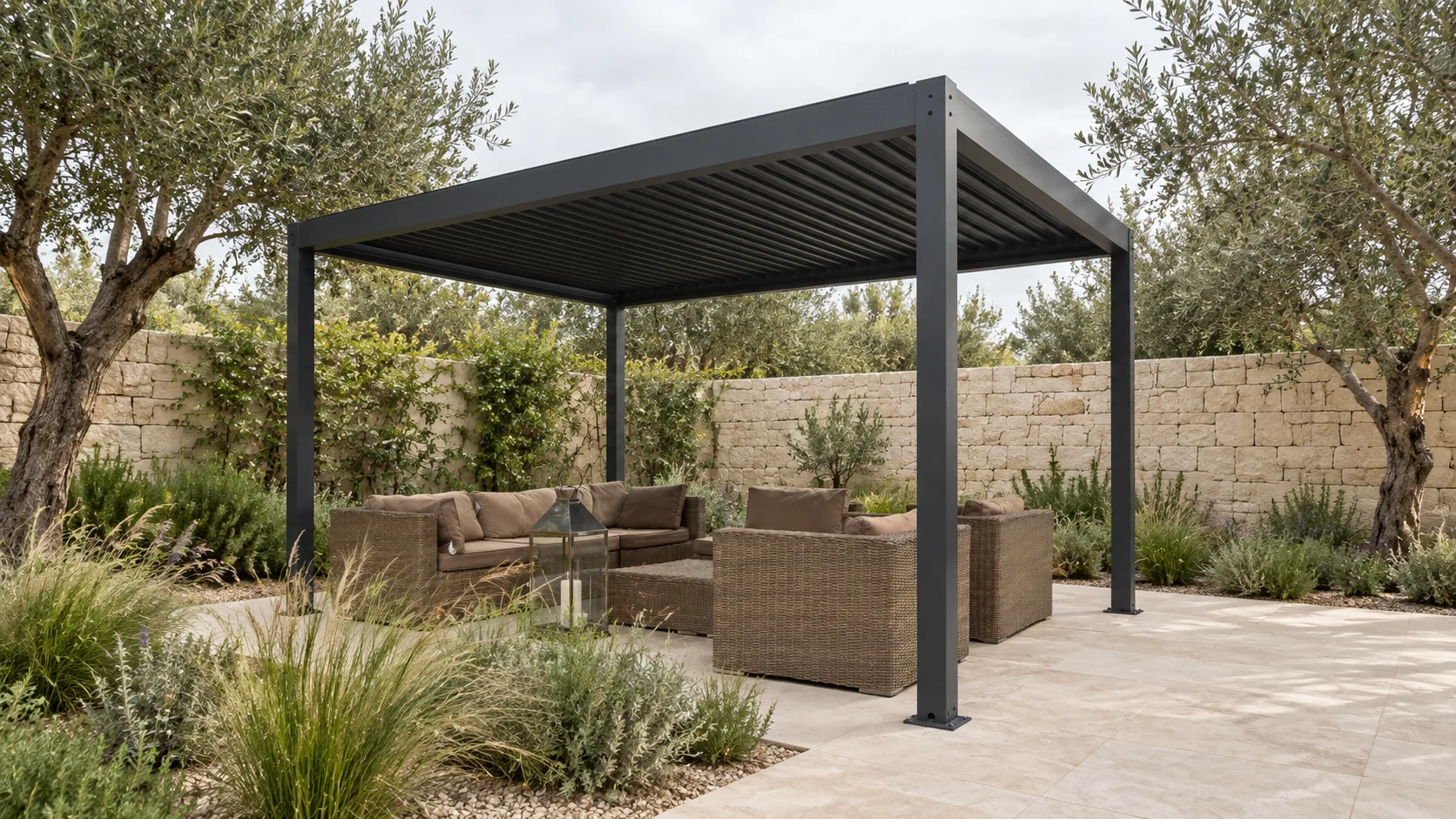
First identify where the sun reaches your seats: through the roof or beneath its edge. A larger roof is not automatically the answer to side glare. Review the exposed opening before choosing a ZIP screen, changing the roof or extending an awning.
Why is there still sun under my pergola?
A roof footprint and a shaded seating area are not the same thing. To investigate your patio, mark where direct sunlight reaches the table, sofa and doorway at the hours you actually use them. Record the date as well: an observation in one season does not describe the whole year.
Low-angle east or west sun may pass beneath overhead shading; adjustable side shading can help. The Australian government’s Your Home shading guide explains this principle. Its orientation advice is written for Australia, so use a local sun-path assessment for your own site.
Reference: general shading principles, not a test report for JY products.
Check the patio before choosing a product
Take one wide photograph showing the roof edge, open sides and furniture. Then take photographs from the affected seat at the beginning and end of your usual patio time. Note the time, city, approximate orientation and the side through which sunlight enters. Avoid sending only a midday product photograph when the problem occurs during dinner.
Separate three observations: direct sun on your face, glare reflected from another surface, and a space that feels hot even in shade. Tell the supplier which you are trying to improve. A shading proposal should not be presented as a guaranteed air-temperature reduction.
Compare the opening, not just the product name
Ask for the proposed roof and side treatment on the same sketch. Mark the seats that must stay shaded and the door or passage that must remain usable. For a louvered roof, compare blade positions; for a retractable roof, identify the remaining opening and panel stack. Neither drawing alone proves the afternoon shadow at your location.
If the side opening is the problem, request the screen’s actual coverage, guide positions, headbox dimensions and remaining gaps. Review the proposed fabric sample against your preferred view. Ask for product-specific performance and operating instructions rather than relying on the words ‘sun protection’ or ‘windproof’.
Which approach should you ask about?
| Option | Question to resolve before ordering |
|---|---|
| Louvered pergola | Does the selected blade position shade the occupied area at the required time, or does sunlight enter from the side? |
| Retractable awning | What mounting height, projection and pitch are proposed? Check the resulting shade and the model’s wind and rain instructions. |
| ZIP screen | Does the screen cover the exposed side without blocking essential access? Confirm fabric, mounting and permitted operating conditions. |
| Glass enclosure | Is the aim enclosure or sun control? Identify the actual glazing specification and any separate shading requirement. |
Do you need to screen every side?
Start with the opening through which the unwanted sunlight enters. Ask whether treating that opening meets the brief before enclosing the whole pergola. On the layout, retain the access you need for dining, garden circulation and cleaning; discuss how the chosen arrangement will affect ventilation.
Clear glass enclosure and solar shading are different specifications. If glass is proposed, ask what glazing is included and what solar-control data is available for that exact option. Do not assume a clear glass wall replaces a shading fabric.
What to send for a useful quotation
Send the site city, photographs with times and dates, a sketch of the exposed side, opening width and height, and the seating position. Say whether dimensions are clear openings or outside frame measurements. For an existing pergola, include frame photographs and the original drawings if available; compatibility needs checking.
List the priority in plain language: ‘Keep this dining table out of direct sun between these hours while keeping this doorway open.’ Ask the quotation to identify the proposed product, coverage, mounting work, electrical provision, operating limits and installation responsibilities. This makes competing proposals easier to compare.
Questions before you choose
Will a bigger pergola stop afternoon sun?
Not necessarily. Ask for a shadow assessment of the seating at the relevant time. An exposed side may need attention even if the roof covers the furniture in plan.
Is a ZIP screen always better than an awning?
They address different openings. Compare a side screen when the problem is side glare, and an awning when overhead coverage is required. Some layouts need both; the site assessment comes first.
Can I keep the garden view?
Include the view in your brief and compare samples of the specified fabric or glazing. Review the proposed screen both deployed and retracted; do not assume all materials give the same visibility.
Discuss your afternoon shade problem
My patio gets direct sun at these times. I can send the location, dated photos and opening dimensions. Please help compare roof and side shading.
Request a quotation →