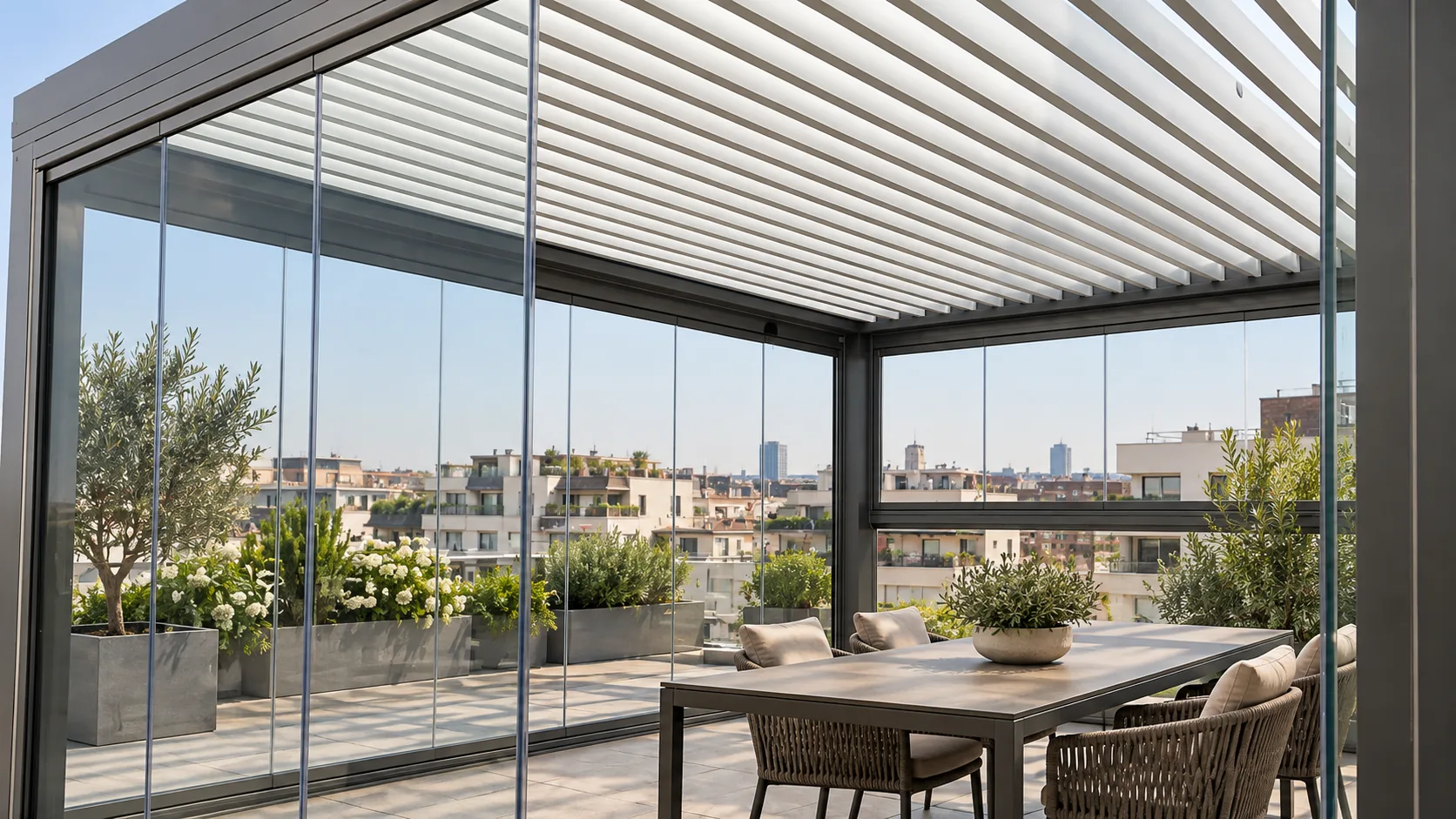
The key difference is roof movement. A rotating-louver pergola adjusts blade angles while the louvers remain overhead. A retractable folding roof moves its panels aside to open the space to the sky. “Bioclimatic” alone does not identify the mechanism. Compare the actual roof operation, module layout, drainage and accessories before choosing a system for your site.
The functional difference
Bioclimatic louvered pergola
The roof uses aluminum blades that rotate between open, angled and closed positions. At an open angle, the blades admit light and ventilation. In the closed position, compatible systems direct water toward integrated perimeter gutters and down through planned drainage routes.
The motorized rotating-louver range provides a starting point for comparing JY180, JY220 and JY250; select the frame and module layout separately from the roof movement.
Retractable folding pergola
The roof blades fold together and travel toward one end or split toward two ends. This reveals a larger section of open sky than rotation alone. The moving stack, drive direction and clear opening must be considered when the module is planned.
What does “retractable bioclimatic pergola” mean?
The name alone does not confirm how a roof moves. Check whether the specified system rotates its louvers, retracts the roof, or combines both movements. Choose by the documented mechanism and your preferred shade or open-sky experience, rather than the category name.
In the JY range, JY180, JY220 and JY250 use rotating louvers, while JY280 uses a retractable folding roof. Compare the retractable pergola range and the JY280 roof system for the relevant product details.
Side-by-side roof comparison
| Decision point | Bioclimatic rotating louvers | Retractable folding roof |
|---|---|---|
| Roof movement | Blades rotate around their long axis | Blades fold and travel toward one or two sides |
| Open-sky area | Partial; blades remain across the opening | Larger; folded blades stack away from most of the opening |
| Light control | Fine adjustment through blade angle | Broader covered-versus-open change |
| Ventilation | Controlled through the louver angle | High airflow when the roof is retracted |
| Rain mode | Closed louvers and integrated drainage, subject to system and installation | Roof closes for cover; folding and sealing details differ from rotating systems |
| Typical priority | Daily sun, shade and airflow control | Alternating between shelter and a larger open roof |
| JY reference | JY160, JY180, JY220, JY250 | JY280 |
Model and module planning
Roof type is only one decision. The total project must be divided into structural bays that stay within a suitable model reference. Connected bays can cover a larger overall space, but the location of shared beams, intermediate posts, motors and drainage routes needs to be shown on the drawing.
JY180
Motorized 180 mm louver system with a catalogue module reference up to 4.5 × 6.0 m.
JY220
Heavy-duty motorized louver system with a catalogue module reference up to 4.5 × 6.5 m.
JY280
220 × 45 mm folding blade, 180 × 180 mm post and catalogue module reference up to 4.0 × 6.0 m.
JY250
Premium motorized louver system with a catalogue module reference up to 7.0 × 6.0 m.
These dimensions are model-selection references, not project-specific structural approval. Exposure, foundations, mounting method and local wind or snow requirements still need review.
Which roof fits each application?
Villa terrace or poolside area
A rotating louver roof is often selected when occupants want frequent shade adjustment throughout the day. A retractable roof is attractive when the terrace should feel fully open in suitable weather.
Restaurant and hospitality terrace
Start with the operating priority. Rotating louvers provide controlled shade and ventilation; a retractable roof can create a stronger open-air transition. Module divisions, lighting, heaters, screens and service routes should be coordinated early.
Rooftop or exposed commercial project
Do not select from appearance alone. Wind exposure, anchoring, drainage, maintenance access and local approvals can be more important than the nominal roof opening.
Accessories affect both systems
ZIP screens, sliding or folding glass, louver walls, integrated LED lighting and heaters can be combined with suitable pergola systems. They should be specified before final drawings because they can affect beam preparation, wiring, clear openings, drainage and control planning.
Five questions that make the choice clearer
- Do users want fine blade-angle control or the largest practical open-sky area?
- How will the total footprint be divided into individual modules?
- Where may posts and shared beams be located?
- Which screens, glass, lighting or heating options are required?
- What exposure, foundation and local compliance requirements apply?
What should I check before choosing a retractable roof?
Ask for the opening direction and folded-panel position to be shown on the project drawing. The overall covered footprint is not the same as the clear open-sky area when the roof retracts.
- Confirm whether the panels gather toward one side or both sides.
- Identify the space occupied by the folded panels and the remaining clear opening.
- Check roof movement against nearby doors, windows, lights and other accessories.
- Keep the required service access and drainage routes clear in the proposed layout.
For JY280, use the confirmed project configuration rather than assuming an opening percentage or independent louver rotation.
Common buyer questions
Is every louvered pergola bioclimatic?
The term is commonly used for adjustable louvered outdoor structures designed to manage sun, airflow and rain response. Product details still matter: check blade movement, drainage, controls and the project-specific installation.
Is a retractable pergola always better?
No. It provides a different outcome. Buyers who value precise daily shading may prefer rotating louvers, while buyers who prioritize a larger opening may prefer a retractable folding roof.
Can several roof types be used on one project?
Potentially, but mixed systems require deliberate module, control and visual coordination. Confirm the layout with the manufacturer before assuming the systems can share every structural detail.
This comparison uses current JY rotating-louver and retractable-roof product references. Final selection depends on project dimensions, exposure, supports, accessories and local requirements.
Technical review: JY Home Shade factory product team · Last reviewed: 26 August 2026